
Dual Lens Security Camera Guide: Wide-Angle + Telephoto Explained (2026)
Table of Contents
A single-lens camera watching a 40 m storefront sees the entrance clearly. A person 25 m away occupies only a handful of pixels, too few to identify when the recording is played back. This is the exact failure a dual lens security camera is built to solve. One wide-angle sensor keeps the whole scene visible. A second telephoto sensor holds enough pixels on the distant target to read a face or a license plate. Installers increasingly deploy dual lens cameras on gates, yards and retail floors. One housing, one mount and one network drop replace what used to require two separate cameras.
This guide explains what a dual lens camera is. It covers the two main configurations: wide + telephoto and color + IR. It also covers panoramic + PTZ models that deliver 360 degree awareness with a tracking detail lens. You will learn what changes versus a single-lens camera and which spec sheet parameters matter. And you will see how to plan bandwidth and storage when every unit streams twice. By the end you will be able to specify a dual lens camera for your site with realistic expectations about cost, image quality and coverage.
Keep reading for more!
The Snapshot
- A dual lens security camera combines two lenses and two image sensors in one housing, processed by a single SoC. Typical pairings are wide + telephoto for coverage plus detail, color + IR for full-color near field plus long-range infrared, and panoramic + PTZ for 360 degree awareness plus a moving detail lens.
- The telephoto lens is the real buying reason: a typical 6 mm tele lens on a 4MP sensor identifies a person at 15-20 m, while the 2.8 mm wide lens next to it only reaches 5-8 m. The second lens multiplies identification distance without losing the wide view.
- Cost math favors dual lens at two-camera sites: a dual lens unit typically costs 1.3-2x a single-lens camera but replaces two cameras, one mount, one PoE cable and one IP address. Installed cost usually drops 30-50% versus two separate units.
- Every dual lens camera doubles the stream burden: two sensors mean roughly 2x the bandwidth and storage of a single camera, typically 16-24 GB/day for a 4MP pair on H.265+. NVR and switch planning must count channels per sensor, not per housing.
- Color + IR dual lens units cover the night gap: the full-color lens (typical F1.0, 20-30 m) keeps court-ready color at the gate while the IR lens (typical 30-60 m) reaches across the yard. One camera, both evidence standards.
What Is a Dual Lens Security Camera?
A dual lens security camera is a network camera that mounts two lenses and two image sensors inside one housing. One system-on-chip processes both streams. The two sensors are usually the same resolution, typical grades being 4MP + 4MP and 5MP + 5MP. They carry different lenses, so each sensor sees a different part of the scene. Buyers searching "dual lens camera" or the distributor shorthand "dual sensor camera" are comparing this hardware class. They need both wide coverage and distant detail from a single mounting point.
The key architectural point is that the two sensors share one camera brain. They share one network connection, one PoE power feed, one IP address and one ONVIF profile. The camera firmware can move data between the sensors. It can crop the telephoto view, overlay it on the wide view, or hand a tracked object from the wide sensor to the tele sensor. That coordination is what separates a true dual lens camera from two separate cameras bolted side by side. Two independent units can never synchronize views the same way.
The three standard configurations cover most demand. Wide + telephoto pairs a 2.8 mm lens with a 6-12 mm lens for coverage plus identification. Color + IR pairs a full-color lens with an infrared lens, so the camera keeps color at close range and reaches further in grayscale at night. Panoramic + PTZ combines a 180 or 360 degree panoramic sensor with a motorized detail lens. That suits sites which need total awareness and a close look on demand. The configuration chosen should match the site geometry, not the marketing sheet.
It is equally important to know what a dual lens camera does not do. It does not double the field of view of a single lens. The two lenses cover different jobs, not double the same one. It does not halve the camera count on a large site, because sight lines still decide mounting positions. And it does not make a small sensor behave like a large one. The low-light physics of sensor size apply per sensor, exactly as they do in single-lens cameras. The dual lens advantage is coordination and mounting economy, not magic.
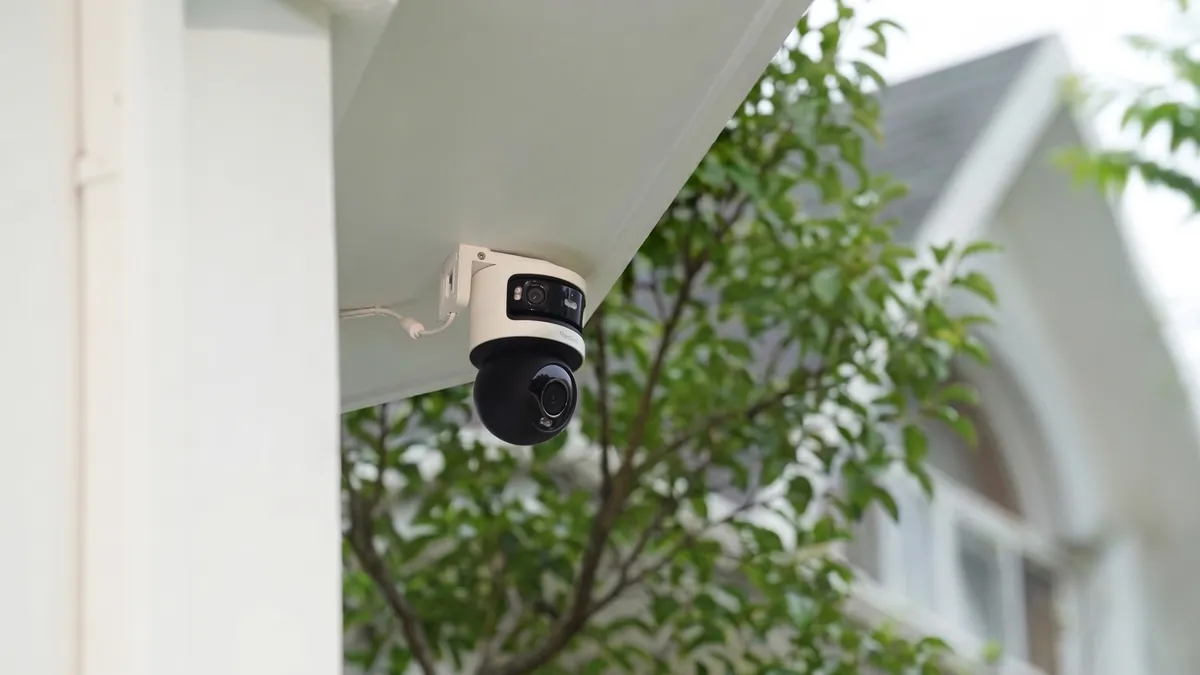
Dual Lens Configurations: Wide + Telephoto and Color + IR
The configuration table below summarizes the three standard architectures. It lists typical lens combos, fields of view and the job each lens does. "Typical" matters here. Exact focal lengths and sensors vary by model, and a responsible spec sheet states both lenses explicitly.
| Configuration | Typical Lens Combo | Typical Field of View | The Second Lens Exists For |
|---|---|---|---|
| Wide + Telephoto | 2.8 mm + 6-12 mm | ~100 deg + ~25-50 deg | Identification at distance while the wide view holds context |
| Color + IR | F1.0 wide + IR wide | ~90-100 deg + ~60-90 deg | Full-color close range (typical 20-30 m) plus IR distance (typical 30-60 m) |
| Panoramic + PTZ | 180/360 deg panoramic + motorized 4-12 mm | ~180 or 360 deg + ~30-90 deg | Always-on full view plus a remotely steered detail lens |
| Dual wide (180 deg) | 2 x 2.8 mm | ~180 deg stitched | One wall or aisle without blind spots, single stitched image |
← swipe to scroll →
Wide + telephoto is the best-selling configuration. It directly answers the question every security buyer asks: how far can I identify someone? The wide sensor keeps the entrance, the aisle or the gate line visible in one frame. The tele sensor holds 2-4x more pixels per degree on the far zone. Color + IR units dominate perimeter and yard sites where night evidence quality matters. Panoramic + PTZ models are the fastest-growing category. One unit replaces a panoramic camera plus a PTZ camera, saving a mounting position, a cable run and a management channel.
Dual Lens vs Single Lens: What Actually Changes
The comparison below lines up a dual lens camera against a single-lens camera. It covers the dimensions that decide a purchase. All figures are typical for 4MP-class hardware.
| Dimension | Single-Lens Camera | Dual Lens Camera |
|---|---|---|
| Field of view | One lens, one angle (typical 25-110 deg) | Two views at once, wide plus tele (typical 100 deg + 25-50 deg) |
| Identification distance | Set by the single focal length (typical 5-15 m) | Tele sensor extends it 2-3x (typical 15-30 m) |
| Night strategy | Color or IR, one choice | Color + IR simultaneously in color + IR models |
| AI functions | Detection in one frame | Detect on wide, track and zoom on tele |
| Bandwidth and storage | 1 stream, typical 8-12 GB/day at 4MP H.265+ | 2 streams, typical 16-24 GB/day at 4MP H.265+ |
| Installed cost per position | 1 camera + 1 cable + 1 mount | 1 housing replaces 2 cameras (typical unit price 1.3-2x) |
| Failure surface | One sensor, one lens | Two sensors in one housing, a single point of failure at the unit |
← swipe to scroll →
The honest summary: a dual lens camera wins wherever one mounting position must serve two jobs, coverage plus detail or color plus range. It loses where the site is better served by separate cameras at separate angles. Two walls of a corner, two sides of a building, or two positions a single housing cannot see. And it carries one structural risk: if the unit fails, both views fail. Mission-critical positions still deserve a second physical camera or a documented spares policy.
For integrators the dual vs single decision is usually a geometry question. Measure the site first. If two jobs can be covered from one mounting point with one sight line, dual lens is typically 30-50% cheaper installed than two cameras. If the site needs two different angles, buy two single-lens cameras, because a dual lens unit cannot look around a corner. The same logic applies to the megapixel trade-offs in our megapixel IP camera guide. Sensor size and lens decide real identification power, in each sensor independently.
Wide + Telephoto: One Camera, Two Fields of View
The wide + telephoto configuration is the closest thing CCTV has to a two-in-one deal. The wide sensor, typically a 2.8 mm lens on a 4MP or 5MP sensor, captures the whole scene. Its typical horizontal field of view is around 100 degrees. The telephoto sensor, typically 6 mm, 8 mm or 12 mm, captures a narrow slice of that same scene. With 25-50 degrees of view, it delivers far more pixels per degree on anything in that slice.
The arithmetic is the whole story: spread 4 million pixels over 100 degrees and each degree gets about 40,000 pixels. Spread the same 4 million over 25 degrees and each degree gets 160,000, which is four times the identification power in the tele view. In practice that is the difference between a face at 8 m and a face at 20 m being readable in playback. The two views are typically shown as a main stream and a picture-in-picture overlay. The operator sees context and detail in one screen.
Smart tracking makes the pairing automatic. The wide sensor runs human and vehicle detection across the full scene. When an object enters a defined zone or crosses a line, the camera reframes the telephoto view to follow it. Typical reframe latency is under one second. The tele view can hold a suspect sharp while the wide view keeps recording everything else. This is a genuine advantage over two separate cameras. The two views are frame-synchronized by the same SoC, so there is no gap between where the person is and what the tele lens shows.
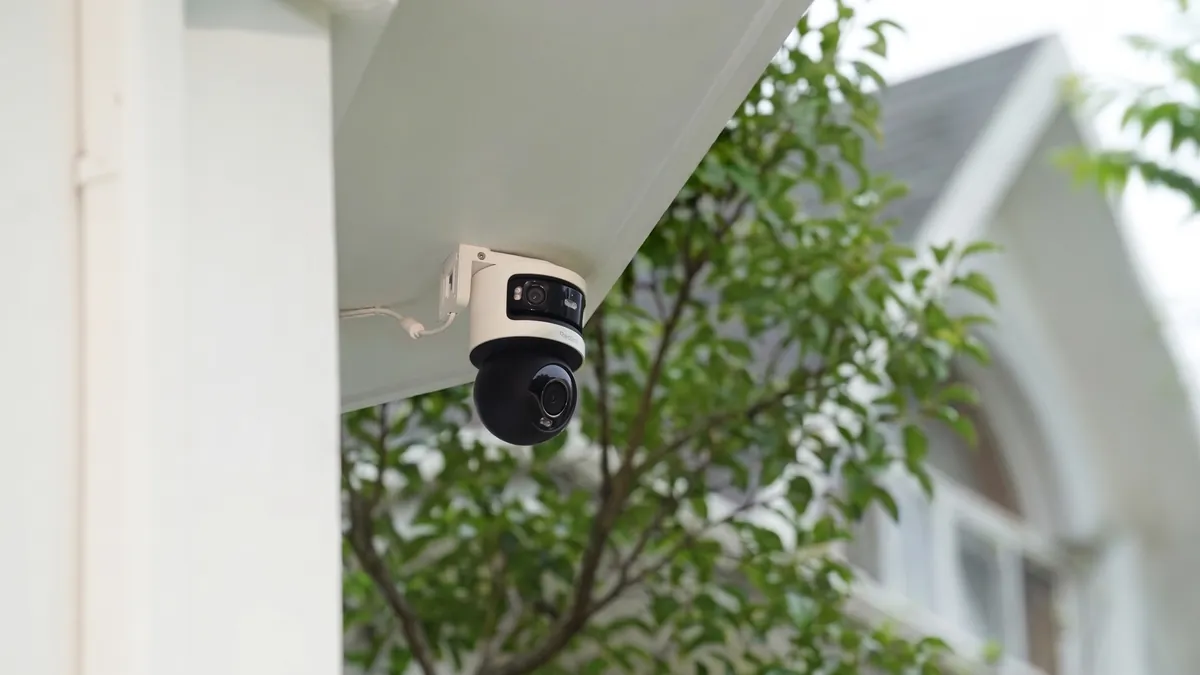
Color + IR: Full-Color Near Field, Infrared Distance
The color + IR configuration answers the night problem with two tools at once. One lens carries the full-color stack: a large sensor (typically 1/1.8-inch), an F1.0 aperture and built-in white-light fill. It records color out to a typical 20-30 m. The second lens carries infrared LEDs and records grayscale out to a typical 30-60 m. Instead of choosing between evidence-grade color and long-range reach, the site gets both from one housing.
The division of labor is what most buyers miss: the color sensor handles the near field where faces, vehicle colors and clothing details matter. The IR sensor covers the distance where the color fill light physically cannot reach. A gate camera, for example, keeps the entry apron in full color for the plate and the driver's face. It simultaneously watches the 40 m approach lane in IR. In playback the operator sees both streams time-synchronized, with no switching and no blind gap while the camera flips modes.
Two practical checks apply to this configuration. First, confirm both lenses are truly independent. Some "dual" night models share one sensor with two lenses, which halves the benefit. A real dual sensor camera runs two image sensors and two streams. Second, confirm the white-light fill is dimmable and schedulable. A 20-30 m color fill that blazes all night on a residential boundary is a complaint magnet. Smart white light that dims to 20% and brightens on motion is the typical compromise.
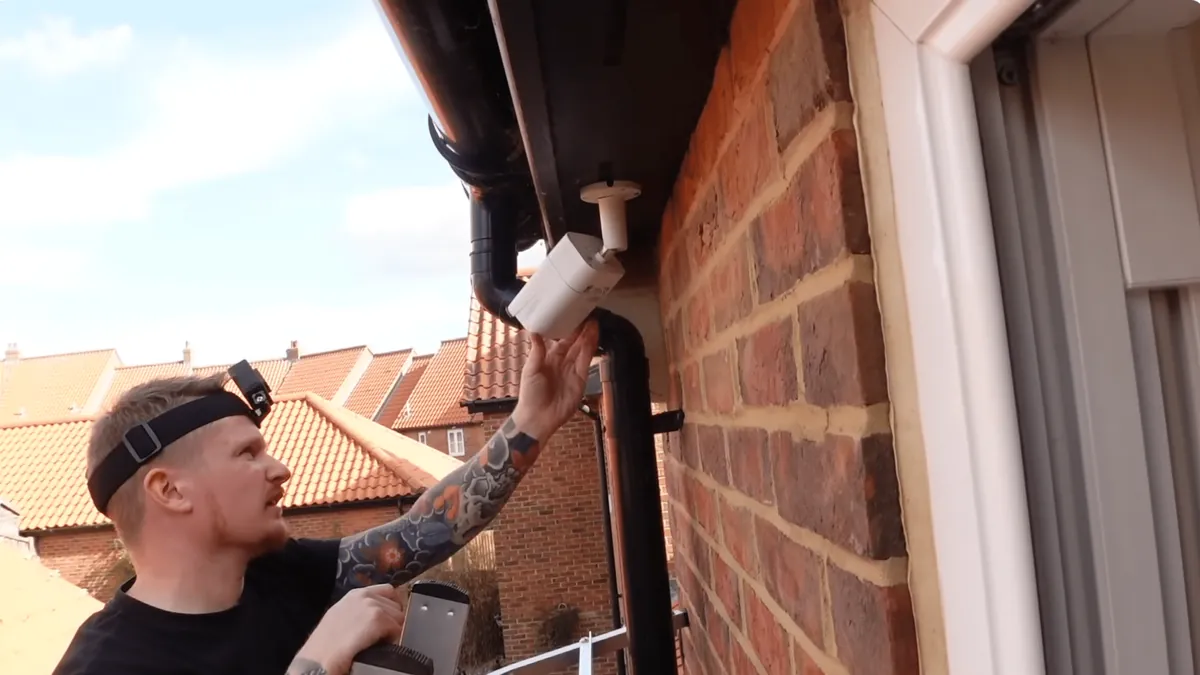
Panoramic + PTZ: 360 Degree Awareness with a Tracking Detail Lens
The panoramic + PTZ configuration is the most ambitious dual lens design. A panoramic sensor keeps the entire site visible at all times. A motorized detail lens, typically 4-12 mm with pan and tilt, moves to examine anything interesting. The panoramic sensor is usually a 180 degree stitched pair or a 360 degree fisheye at a typical 4-8MP. The PTZ section adds typical pan rotation of 0-355 degrees and tilt of 0-90 degrees. The pair covers a full circle with no blind spots.
The operating model is "detect wide, examine narrow": the panoramic view always records everything. The PTZ lens follows motion automatically or on operator command to capture identification-grade close-ups. Without this pairing, a conventional PTZ camera points one way and misses everything behind it. With the panoramic lens, the operator always sees the full scene. They can verify what the PTZ is looking at, and why. This is why the configuration is popular on yards, school perimeters and warehouse perimeters, where a single PTZ alone leaves blind zones.
The economics only work when one mounting position can see the whole site, typically a pole, mast or high wall corner. A panoramic + PTZ unit is the most expensive dual lens class, typically 2-4x a single-lens camera. But it replaces a panoramic camera plus a PTZ camera plus their separate cabling and channels. On a site that genuinely needs both, installed cost usually lands 20-40% below the two-camera alternative. Management is simpler too: one IP address, one firmware, one maintenance visit. For the panoramic half of this pairing, our WiFi panorama camera guide covers sensor and stitching details in depth.
AI Features That Make the Second Lens Useful
A second lens is only worth its pixels if the camera brain can use it. The AI features below turn a dual lens camera from a curiosity into a site tool. All of them are standard on current models, and none require a subscription or cloud service.
- Smart tracking. Human or vehicle detection on the wide sensor hands the target to the telephoto or PTZ sensor, which reframes and follows. Typical reframe latency is under one second, and the tele view holds 2-4x more pixels per degree on the target.
- Picture-in-picture overlay. The tele view is embedded in the wide stream, so one NVR channel shows context and detail together. Useful for gate, aisle and dock positions.
- Perimeter and line-crossing alarms on both sensors. Independent rules per lens: the wide lens watches the boundary, the tele lens watches the entrance. Two virtual fences from one camera.
- People counting and heat mapping. The wide sensor counts traffic across a doorway while the tele sensor captures identification frames of the same people. This is retail loss prevention's standard dual use.
- Vehicle and plate capture on the tele lens. The tele sensor is aimed at the lane while the wide sensor keeps the full yard context. A common gate configuration without a dedicated ANPR unit.
For AI-heavy sites, check whether the model is an AI camera with analytics running on-board. Typical detection ranges are 30-60 m for humans and 60-100 m for vehicles. On-board AI keeps bandwidth at the base stream rate and removes the latency of cloud processing. The second lens multiplies what that AI can do: detection coverage from the wide view, identification quality from the tele view.
Selection Parameters: Reading a Dual Lens Spec Sheet
Dual lens spec sheets hide the details that matter in the fine print. The table below is the checklist to run line by line. It shows typical values for 4MP-class hardware and the red flags that should kill a candidate.
| Spec Line | What to Check | Typical Value | Red Flag |
|---|---|---|---|
| Sensor per lens | Two sensors stated separately, with sizes | 1/2.7 inch or 1/1.8 inch per sensor | One sensor shared by two lenses |
| Resolution per lens | Each sensor's pixel count | 4MP + 4MP or 5MP + 5MP | "Up to 8MP" with one sensor at 2MP |
| Focal length per lens | Both lenses named in mm, not "varifocal" generically | 2.8 mm + 6-12 mm | Only one focal length listed |
| Night specification | Color range and IR range stated separately | 20-30 m color + 30-60 m IR | One blended "night range" number |
| Power draw | Watts and PoE class | 10-15 W, PoE+ (802.3at) | Stated as 802.3af with two sensors |
| Streams and ONVIF | Independent streams per sensor, ONVIF Profile S/T | 2 main + 2 sub streams | Second lens streams only through the app |
| Environmental rating | Outdoor models need IP66 or better | IP66/IP67 | IP54 on an outdoor gate position |
← swipe to scroll →
The two questions that filter most candidates: does the sheet state two independent sensors, and does it state the focal length of both lenses? A dual lens camera that shares one sensor is a marketing trick. A sheet that hides the second lens's focal length cannot be specified. If the supplier cannot answer both questions, move on.
Also check that the form factor matches the mount. Dual lens bullets suit poles and walls. Dual lens domes suit ceilings and corridors where vandal resistance matters. Dome cameras in the dual lens class are a common choice for retail floors. The mounting position decides which housing survives the site. A pole-mounted bullet suits a gate, a ceiling dome fits a lobby, and a weatherproof turret covers a wall corner.
Bandwidth, Storage and NVR Planning for Dual Streams
Every dual lens camera is two cameras from the network's point of view. Plan bandwidth, storage and NVR channels per sensor, not per housing. A 4MP dual lens pair on H.265+ typically records 16-24 GB/day and streams 4-8 Mbps. A single 4MP camera records 8-12 GB/day and streams 2-4 Mbps. A 16-housing dual lens deployment behaves like 32 channels. It typically needs a 2x larger recorder than the equivalent single-lens site.
The NVR math: count channels as the sum of sensors. A 16-channel NVR holds 8 dual lens units at full dual-stream recording. It holds 16 if only the wide stream is recorded continuously and the tele stream is event-only. Many dual lens models support per-sensor recording schedules. Record the wide view 24/7 and the tele view on motion. That typically cuts storage 30-50% while keeping both views available for every alarm.
Switch sizing follows the same rule. A dual lens unit drawing a typical 10-15 W needs PoE+ (802.3at) budget per port. The port group must carry the combined bandwidth of both streams. For a 16-housing dual lens site, plan a PoE+ switch with 2x the per-port budget of a single-lens deployment. Verify the NVR's incoming bandwidth too, because 32 channels at 4-8 Mbps saturates a recorder's gigabit uplink far faster than 16 channels would. The IP camera guide walks through channel budgeting and recorder sizing step by step.
Applications: Where Dual Lens Cameras Earn Their Cost
Dual lens cameras pay for themselves at positions that must serve two jobs. The recurring deployments below cover most commercial demand, with typical configurations for each.
- Gates and entrances (wide + telephoto). Wide sensor watches the whole apron; tele sensor reads the plate and the driver's face. Typical: 4MP + 4MP, 2.8 mm + 6 mm, gate pole mount.
- Yards and perimeters at night (color + IR). Color sensor keeps the fence line in evidence-grade color; IR sensor reaches across the yard. Typical: 5MP F1.0 color + IR pair, 30-60 m total reach.
- Retail floors and aisles (wide + telephoto, dome). Wide sensor counts and covers; tele sensor captures faces at the till and the exit. Typical: 4MP + 4MP dome, ceiling mount.
- Parking lots and school perimeters (panoramic + PTZ). Panoramic view records everything; PTZ follows incidents. Typical: 180 degree panoramic + 4-12 mm PTZ on a pole or mast.
- Loading docks and truck bays (wide + telephoto). One camera covers the bay door and the yard behind it, with the tele sensor on the plate zone. Typical: 4MP + 4MP, 2.8 mm + 8 mm.
The common thread: every application pairs one always-on view with one detail view, from a single mounting position. If a position needs that pairing, dual lens is usually the lowest-cost way to get it. If it needs two separate angles, separate cameras remain the right answer. Sites mixing both usually end up with a dual lens fleet at the perimeter and single-lens units inside. Keeping the whole deployment on one supplier's IP camera line keeps firmware, ONVIF and spare parts uniform.
Dual Lens Camera Questions Buyers Ask
What is a dual lens security camera?
A dual lens security camera mounts two lenses and two image sensors in one housing, sharing one SoC, one network connection and one IP address. Typical configurations are wide + telephoto for coverage plus detail, and color + IR for color plus range. Panoramic + PTZ adds full awareness plus a tracking detail lens.
What is the difference between a dual lens camera and two separate cameras?
A dual lens camera synchronizes both views in one SoC. Smart tracking can hand a target from the wide sensor to the tele sensor, and the views are frame-aligned. Two separate cameras operate independently and cost two mounts, two cables and two IP addresses. The dual lens unit is typically 30-50% cheaper installed when one position can serve both jobs.
Are dual lens cameras better than single lens?
At positions that need both wide coverage and distant detail, yes: the tele sensor multiplies identification distance 2-3x while the wide sensor keeps context. At positions that need one angle only, a single-lens camera is simpler, cheaper and has fewer failure points. Choose by the site's geometry, not the feature list.
Do dual lens cameras use more bandwidth and storage?
Yes, roughly double a single camera of the same resolution. A 4MP pair on H.265+ typically uses 16-24 GB/day and 4-8 Mbps. Plan NVR channels and switch ports per sensor, and use per-sensor recording schedules to record the tele view on motion only.
Can a dual lens camera record color and infrared at the same time?
In color + IR configurations, yes. The full-color sensor records color to a typical 20-30 m. The IR sensor records grayscale to a typical 30-60 m, both time-synchronized in one housing. Confirm the sheet states two independent sensors, not one sensor shared by two lenses.
What does dual sensor camera mean?
"Dual sensor camera" is the distributor shorthand for the same hardware class: two image sensors feeding one camera brain. It is used interchangeably with "dual lens camera". The sensors are the part that matters, because each sensor needs its own lens to form an image.
The Bottom Line
A dual lens security camera is the right tool when one mounting position must serve two jobs. The two jobs are wide coverage plus distant detail, or full color plus infrared reach. Choose wide + telephoto for gates, aisles and docks. Choose color + IR for yards and perimeters after dark. Choose panoramic + PTZ where a single position must see everything and examine anything. Plan every deployment as two channels per housing. Confirm the spec sheet states two independent sensors with both focal lengths. Buy from a supplier that will answer the sensor and lens questions line by line.
At FULLCOLORCAM in Guangzhou we build 4MP and 5MP full-color night vision IP cameras with 1/1.8-inch sensors and F1.0 lenses. Our range also includes dual lens and panoramic + PTZ models for gate, yard and retail deployments. Every unit is tested before shipping, ONVIF-conformant and with free P2P remote access. Email cj226144@gmail.com with your site plan and identification distances for a spec-matched dual lens quote.
NEXT STEP
Ready to Upgrade to Full-Color Night Vision?
Send us your requirements — our team responds by email.
Written by
Ray ChanCCTV Buyer's Guide Author · Full-Color Night Vision Specialist. Ray helps global importers and integrators source factory-direct security cameras.