
Best PTZ Camera Guide: The 2026 Parameter Checklist for Pan Tilt Zoom Buyers
Table of Contents
The best ptz camera is not the one with the biggest zoom number on the box. It is the one whose parameters match the scene, the night and the patrol schedule. A 36x optical zoom head is a wasted purchase if its presets drift. It is also wasted if the telephoto footage at night is black, or if the housing leaks after one winter. Most PTZ buying mistakes are parameter mistakes. Buyers pay for digital zoom that destroys detail. They skip the preset count. They choose IR night vision when the site needs color evidence.
This guide judges every pan tilt zoom camera by six parameters and one procurement checklist. The six: optical zoom, pan and tilt speed, presets and auto tracking, night vision, weatherproofing, and network and power integration. Every number is a typical value you can verify on a spec sheet. Every section ends with a buying tip for B2B buyers. By the end you will be able to compare any two ptz security camera quotes by parameter, not by marketing.
Keep reading for more!
The Snapshot
- Optical zoom is the first parameter to check: 20x is the outdoor floor, 25x-36x is for faces and plates beyond 50 m, and digital zoom never counts for evidence.
- Speed class defines patrol capability: manual pan from 0.1°/s for fine aiming up to 300°/s for repositioning, with preset jumps at 200-360°/s and 360° continuous pan for 24/7 patrols.
- Presets are the memory map of the site: 128 positions is the serious-buyer floor, 256-512 for large sites, with 1-8 patrol patterns and 8-15 second dwell times per stop.
- Night performance decides evidence quality: a full-color PTZ keeps working color down to 0.01 Lux, while an IR unit records grayscale shapes that cannot describe a vehicle color.
- Outdoor PTZ hardware is a sealed system: IP66 is the baseline, the typical operating range is -20°C to +55°C with an internal heater, and the PoE+ budget is 25.5W when heater and wiper are active.
What Makes a PTZ Camera the Best Choice
"Best" without a scene is a marketing word. The best ptz camera for a warehouse yard is different from the best ptz camera for a gas station forecourt. That is why this guide refuses third-party ranking lists and brand-based awards. Those lists never tell you whether a camera pans 355° or 360° continuously. They never tell you whether night illumination covers the telephoto field, or whether the supplier answers a firmware question after the MOQ ships. Instead, every camera is judged on the same six parameters plus procurement terms.
The parameter method works because every ptz security camera publishes the same numbers on its spec sheet. This is true from a mini dome to a high-speed class head. You compare optical zoom in x. Pan range is in degrees. Speed is in degrees per second. Presets are in count. Night sensitivity is in Lux. Housing is in an IP rating. The camera that wins the comparison for your scene is the one to buy, regardless of the logo on the housing.
A fair comparison takes about ten minutes with two spec sheets side by side. Start with the parameter that matches your hardest requirement, usually zoom or night vision. Then work down the list. When two cameras tie on parameters, compare procurement terms: MOQ, lead time, warranty, firmware updates and sample policy. That tiebreaker is where factory-direct suppliers win.
Optical Zoom: The First Parameter to Check
What it means: optical zoom is the ratio between the shortest and longest focal length of the lens. A 36x optical zoom with a 4.6-167mm focal range magnifies the scene 36 times from wide to telephoto. The number is honest only when it is optical. Digital zoom crops pixels and adds nothing for identification.
Why it matters: zoom decides identification distance, the most expensive property in a security system. A 25x unit reads a human face at roughly 60 m. A fixed 4MP lens manages a fraction of that. For plates, faces and labels at distance, zoom is the parameter you cannot fix after installation.
| Zoom class | Typical focal range | Face ID distance | Best for |
|---|---|---|---|
| Mini PTZ 4x-10x | 2.8-12mm class | ~10-20 m | Shops, offices, driveways |
| Standard outdoor 20x | 4.8-96mm class | ~40-60 m | Yards, warehouses, parking |
| Long-range 25x | 4.8-120mm class | ~50-70 m | Perimeter, loading bays |
| Full-color 36x | 4.6-167mm class | ~80-100 m | Large sites, plate capture |
← swipe to scroll →
High zoom has one consequence: a narrow telephoto field. At 36x the horizontal field of view drops to about 2.3°, roughly the width of a doorway at 100 m. Aiming, mounting rigidity and night illumination all have to survive that narrow cone. That is why the other parameters in this guide matter more on a 36x unit than on a 10x unit.
Selection tip: ask for the focal range in millimeters, not just the zoom ratio. Demand that the quote state "optical" explicitly. If a spec sheet headlines a total zoom number that adds optical and digital together, subtract the digital part before comparing.
Pan/Tilt Range and Rotation Speed
What it means: pan range is horizontal rotation, either 355° with a mechanical stop or 360° continuous. Tilt range typically spans -5° to 90°. Speed is measured in degrees per second, from 0.1°/s for fine aiming up to 300°/s for fast repositioning. A speed dome is the classic high-speed PTZ dome class that combines 360° continuous pan with fast preset jumps.
Why it matters: range and speed decide whether the camera can patrol the whole site and still respond to an alarm. A 355° unit must unwind between patrols. A 360° unit rotates endlessly in either direction. On a 24/7 patrol schedule that difference repeats hundreds of times a day.
| Spec | Mini / indoor | Standard outdoor | High-speed speed dome |
|---|---|---|---|
| Pan range | 355° stop | 355° or 360° | 360° continuous |
| Tilt range | 0° to 90° | -5° to 90° | -10° to 90° |
| Manual pan speed | 0.1°-60°/s | 0.1°-150°/s | 0.1°-300°/s |
| Preset jump speed | ~60°/s | ~200°/s | 240°-360°/s |
| Typical use | Shop, office | Yard, warehouse | Perimeter, city |
← swipe to scroll →
Auto-flip matters at high mounts. Instead of tilting through a mechanical stop, the head flips 180° in pan and keeps tracking, so the image never inverts. Verify auto-flip if vehicles or people pass directly under the mount.
Selection tip: for patrol sites choose 360° continuous pan and a preset jump speed of at least 200°/s. Top speed alone does not make a better camera. A patrol running at 30-100°/s produces footage operators can actually watch. A 300°/s sweep is for repositioning, not recording.
Presets and Auto Tracking
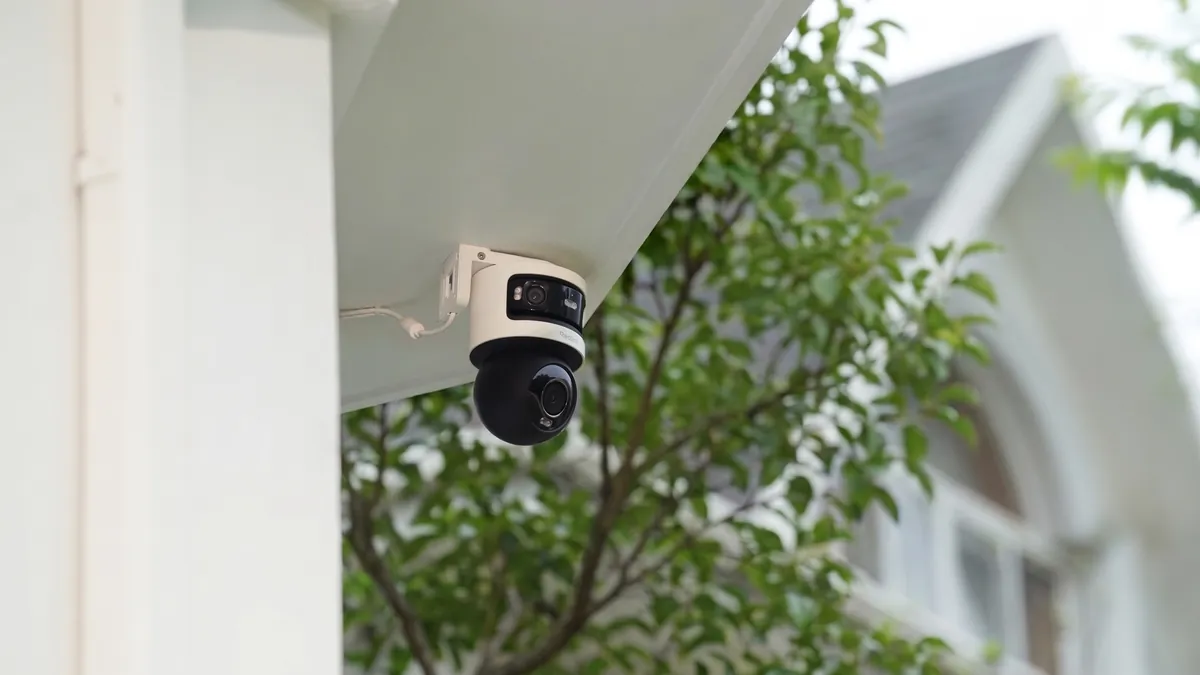
What it means: a preset stores the pan, tilt and zoom coordinates of one view. Typical units hold 128 positions, with high-end models reaching 512. Patrol patterns chain presets into a route. Auto tracking locks onto a detected object and follows it.
Why it matters: presets turn a camera into a site map: gate, delivery bay, fuel pumps, east fence. Scheduling decides when the route runs, so the camera watches the yard after hours and rests on the entrance during the day. Auto tracking adds response. When a sensor or a fixed camera fires, the PTZ swings to the linked preset and follows the target.
Good preset design is a site map, not a random list. Number the gate, the delivery bay, the fuel pumps and the fence corners in patrol order. Give each stop a dwell time of 8-15 seconds so coverage stays meaningful. Most units also support a home position, the default resting view, and privacy masks that blank out windows and neighbor property. Privacy masks matter on every site where the patrol sweeps past a staff area or a public road.
Selection tip: count presets, patrol patterns and scheduling in the spec, and confirm recall accuracy. A good unit returns to a preset within about 0.1°. A weak unit overshoots by degrees and wobbles. Enable auto tracking only in low-traffic zones. Set a tracking timeout so the head returns to patrol. Otherwise it chases a parked car all night.
Night Vision: Full Color vs IR at Telephoto
What it means: a PTZ records after dark either with IR illumination or with full-color low-light technology. An IR unit lights the scene with 850nm LEDs and records grayscale. A full-color unit uses a large-aperture lens and a high-sensitivity sensor. It keeps working color down to about 0.01 Lux. White-light fill covers zero-light scenes.
Why it matters: the telephoto cone changes the night problem. At 36x zoom the field is about 2.3°. Illumination must cover that narrow cone at distance. An IR array rated for 80 m at wide angle may not reach 80 m at full telephoto. A full-color 36x PTZ keeps color detail where grayscale would fail. Color is the detail a police report needs.
| Factor | IR PTZ | Full-color PTZ |
|---|---|---|
| Night image | Grayscale | Color |
| Typical sensitivity | 0 Lux with IR on | 0.01 Lux color |
| Telephoto coverage | IR throw shrinks at zoom | White-light fill tracks the cone |
| Evidence value | Shapes, no color | Vehicle and clothing color |
| Typical cost | Lower | Higher, falling fast |
← swipe to scroll →
Selection tip: ask the supplier for night footage at maximum zoom, not the marketing still at wide angle. Check the aperture at telephoto. A lens that opens to F1.6 at wide may close to F4.8 at full zoom. That costs several stops of light exactly when you need detail.
Two details separate a serious night spec from a marketing one. The first is the aperture range. A 36x lens opens to F1.6 at wide angle. It closes to F4.8 at telephoto, losing about three stops of light across the zoom range. The second is wide dynamic range. A sensor with 80dB WDR keeps detail when a bright headlight crosses a dark yard. Ask for both numbers in writing.
Weatherproofing and Explosion-Proof Builds
What it means: weatherproofing is the IP rating. IP66 means dust-tight and protected against powerful water jets. IP67 adds temporary immersion. Explosion-proof builds go further. Certified housings protect hazardous atmospheres such as oil and gas, paint booths and grain handling. An electrical spark inside the camera could ignite those environments.
Why it matters: a ptz camera outdoor installation lives or dies on seals. The head rotates against gaskets on every patrol, so outdoor PTZ housings fail years before fixed cameras do. A full operating range of -20°C to +55°C with an internal heater keeps the lens clear in freezing winters. Surge protection of 6KV on the network port keeps the first lightning strike from killing the fleet.
Selection tip: for any ptz camera outdoor install, check the cable entry seal as carefully as the camera body. That is where water actually gets in. Outdoor ptz units in coastal or industrial sites should come with salt-spray test reports. For hazardous sites, demand the explosion-proof certification documents, not a marketing phrase.
Network, Power and Integration
What it means: a ptz ip camera is a network device. It streams over RTSP, controls over ONVIF Profile S and integrates through an HTTP API. Power comes from PoE+ (802.3at, up to 25.5W) or a dedicated DC supply. H.265 compression keeps a patrol stream at roughly 2-4 Mbps. A ptz camera wifi build swaps the Ethernet run for wireless uplink where cabling is impractical.
Why it matters: PTZ cameras expose motor control. A compromised camera is a camera someone else is driving. Integration also decides whether your NVR can recall presets on alarm, and whether mixed fleets of dome, bullet and PTZ units record into one timeline.
Selection tip: confirm ONVIF PTZ commands work from your recorder before accepting delivery, not just video. Assign a static IP or DHCP reservation. Keep credentials strong. Test preset recall from the app you will actually use.
The most useful integration pattern is alarm linking. A fixed camera covers a chokepoint and detects motion. Its event fires a command that swings the PTZ to the preset nearest that zone. The PTZ arrives in about one second at a 200°/s preset speed and records the detail the fixed camera cannot. Every serious NVR and VMS supports this pattern, but only if the PTZ speaks ONVIF PTZ commands, not just video.
Matching PTZ Parameters to the Scene
The parameters only mean something against a scene. The table below matches typical sites to a parameter set. Treat every value as a starting point, not a rule.
| Scene | Zoom | Pan | Night | Typical config |
|---|---|---|---|---|
| Warehouse yard | 20x-25x | 360° | Full color | Patrol 6-8 presets after hours |
| Parking lot | 20x-25x | 360° | Full color | One head per 80-150 spaces |
| Gate with plate capture | 25x-36x | 355° enough | IR or full color | Preset on the lane, event recall |
| Perimeter fence | 25x-36x | 360° | Full color | Auto tracking, low traffic zone |
| Gas station forecourt | 20x | 360° | Full color | Patrol plus till preset |
| Construction site | 25x | 360° | IR acceptable | Solar or 4G power, event recording |
← swipe to scroll →
The pattern behind the table: zoom follows distance, pan follows patrol, night follows evidence needs, and power follows the site. A site that must identify people at 60 m needs 25x or more. A site that must describe a vehicle color at 3 am needs full-color night vision more than it needs 36x.
The hybrid pattern worth copying on real sites: fixed cameras on the entrances and tills, one PTZ in the open area. The fixed cameras never miss the chokepoints. The PTZ patrols, zooms and follows. Storage stays low because one PTZ stream at 2-4 Mbps with H.265 costs less than four fixed streams. Coverage stays complete because the fixed cameras hold the permanent zones.
The Procurement Parameter Checklist
When a buyer asks which best ptz camera to order, walk this checklist in order. Every line maps to a specification you can demand from a supplier.
- 1. Confirm optical zoom. 20x minimum for outdoor, 25x-36x for distance work. Reject "total zoom" numbers that include digital.
- 2. Check pan range and preset speed. 360° continuous for patrols, preset jumps at 200°/s or faster, auto-flip if vehicles pass under the mount.
- 3. Count presets and patrols. 128 positions minimum, 1-8 patrol patterns, scheduling and dwell time control.
- 4. Demand night footage at max zoom. Full-color down to 0.01 Lux, or IR with a telephoto-range figure. Never accept a wide-angle still.
- 5. Verify the housing. IP66 minimum, heater and operating range for your climate, 6KV surge protection, sealed cable entry.
- 6. Confirm integration. ONVIF Profile S with PTZ commands, RTSP, H.265, PoE+ or DC power, and a credentials policy.
Certifications close the checklist. CE, FCC and RoHS cover the main export markets. NDAA-compliant builds are increasingly required for government and institutional tenders. Ask whether the factory can supply test reports and a certificate of conformance with each shipment. A supplier that cannot document compliance will cost you more in customs and audits than the unit saved.
On the procurement side, ask about MOQ, typically 10-50 units. Ask about lead time, typically 15-30 days at volume. Confirm the warranty, the RMA process and the firmware update policy. Two years is standard at factory level. Order 2-3 samples and run a fixed test protocol. Zoom through the full range. Recall 20 presets and measure accuracy. Run a 48-hour patrol. Spray the housing. Record night footage at maximum zoom. A supplier who resists samples will not improve after the purchase order.
PTZ Camera Questions Buyers Ask
What does PTZ stand for in a security camera?
PTZ stands for pan, tilt, zoom. A pan tilt zoom camera is one motorized head that rotates horizontally, rotates vertically and zooms. It replaces three or four fixed cameras for coverage, with one tradeoff: it watches one direction at a time.
How far can a 36x optical zoom PTZ camera see?
At 25x optical, a PTZ reads a human face at roughly 60 m. A 36x unit with a 4.6-167mm lens narrows the field to about 2.3° at full telephoto and reads plates and signage at distance. Optical zoom keeps the full sensor behind every step.
Is optical zoom or digital zoom better for a PTZ?
Optical. It moves glass elements, so the full sensor fills the frame at every step. Digital zoom crops pixels and destroys detail. If a spec sheet headlines a big total zoom number, check the optical number: that is the one that matters for identification.
What is a speed dome camera?
A speed dome is a high-speed PTZ dome: 360° continuous pan, fast preset jumps of 200-360°/s and precise tracking. The name comes from the dome housing and the speed rating. Speed domes are the standard class for perimeter and city surveillance.
Do PTZ cameras work at night?
Yes. IR models record grayscale with LED illumination. Full-color models keep working color down to about 0.01 Lux with white-light fill. For a PTZ, verify night performance at maximum zoom, because the telephoto field narrows and illumination must cover it.
How many presets do I need on a PTZ camera?
128 is the serious-buyer floor for a multi-zone site. 256-512 suits large perimeters. Presets are only useful with patrol patterns and scheduling: chain 6-8 presets into a route with 8-15 second dwell times.
What does IP66 mean for an outdoor PTZ camera?
IP66 means dust-tight and protected against powerful water jets. It is the practical floor for any outdoor installation. IP67 adds temporary immersion. For a PTZ, check the cable entry seal too, since the rotating housing flexes gaskets on every patrol.
How much bandwidth does a PTZ camera use?
A patrol stream at H.265 runs roughly 2-4 Mbps. Auto tracking adds nothing when idle. Recording at full zoom does not change the bitrate much, because the encoder rate-limits the stream. Budget for one stream per PTZ, plus the fixed cameras around it.
The Bottom Line
The best ptz camera is the one that passes your parameter checklist for the scene you actually have. Start with optical zoom for distance. Add 360° continuous pan and fast presets for patrol. Choose full-color night vision where evidence color matters. Verify IP66 and the heater for the climate. Confirm ONVIF integration before the MOQ. Fixed cameras stay at the chokepoints. One PTZ patrols everything else.
At FULLCOLORCAM we build a 5MP full-color PTZ dome line. It carries 36x optical zoom (4.6-167mm) and 0.01 Lux color sensitivity. It includes 128 presets, an IP66 housing and ONVIF conformance. Every unit ships factory-direct with OEM/ODM support and no MOQ on mixed solution orders, plus a 1-year warranty. Email cj226144@gmail.com with your site distances and patrol hours for a spec-matched quote.
NEXT STEP
Ready to Upgrade to Full-Color Night Vision?
Send us your requirements — our team responds by email.
Written by
Ray ChanCCTV Buyer's Guide Author · Full-Color Night Vision Specialist. Ray helps global importers and integrators source factory-direct security cameras.